In the world of gourmet food production, olive oil is rightfully celebrated as “Liquid Gold.” However, unlike actual gold, this precious liquid is biologically volatile. From the moment it is pressed until it reaches the consumer’s salad, olive oil is in a constant battle against its greatest chemical enemy: Oxidation.
As a manufacturer, your ultimate goal isn’t just to fill bottles; it’s to preserve the sensory and nutritional integrity of the oil. A flawless filling process is the final line of defense. In this guide, we will analyze the mechanics of oxidation during the packaging stage and explore how Bottom-Up Filling and Anti-Foam systems act as the primary guardians of olive oil quality.
1. Oxidation: The Silent Quality Killer
Oxidation is a chemical reaction that occurs when oxygen interacts with the fatty acids in olive oil. This process triggers a chain reaction that permanently degrades the product:
Rancidity: The fresh, fruity, and peppery notes of premium extra virgin olive oil (EVOO) are replaced by a “cardboard-like” or “greasy” off-flavor.
Nutritional Depletion: Olive oil is a powerhouse of polyphenols (antioxidants) and Vitamin E. Oxidation scavenges these molecules, neutralizing the health benefits that consumers pay a premium for.
Increased Peroxide Value: High peroxide levels are a direct indicator of primary oxidation. Once this value exceeds international standards (20 meq O2/kg), the oil is technically no longer “extra virgin.”
The “enemies” of olive oil are light, heat, and oxygen. While dark glass bottles handle light, and climate-controlled warehouses handle heat, the filling machine is responsible for the oxygen.
2. Why Filling is a “High-Risk” Moment
The transition from a storage tank to a retail bottle is the moment when olive oil is most exposed to the atmosphere. Several factors can spike oxidation levels during these few seconds:
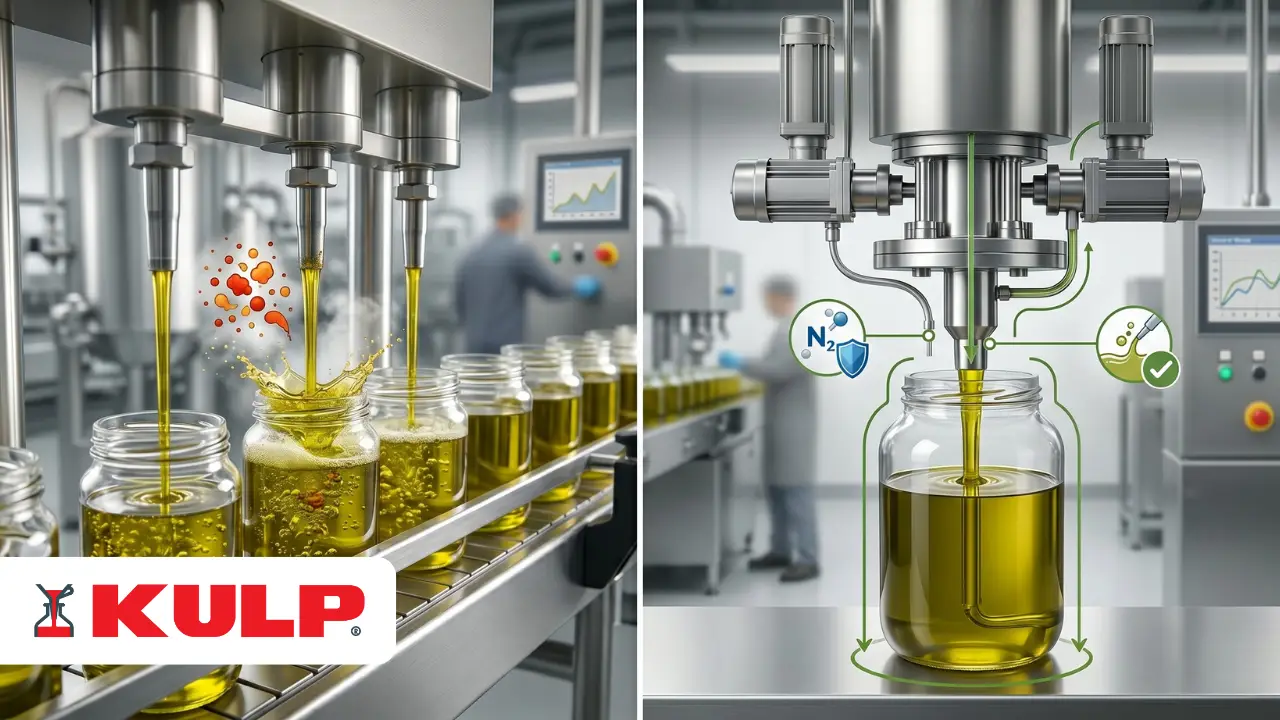
Air Entrainment: If oil is splashed into a bottle from a height, it traps air within the liquid mass.
Turbulence and Foaming: High-speed filling can cause the oil to churn and foam. Foam consists of thousands of microscopic air bubbles, providing a massive surface area for oxygen to react with the oil.
Headspace Oxygen: After the bottle is filled, the air trapped between the oil level and the cap continues to oxidize the product throughout its shelf life.
3. The Bottom-Up Filling Technique: Mechanical Defense
To combat these risks, Kulp Machinery utilizes the Bottom-Up Filling (Diving Nozzle) technique. This is the industry standard for high-viscosity or oxygen-sensitive liquids.
The Engineering Logic:
Instead of “pouring” the oil from the top of the bottle, the filling nozzle dives deep to the very bottom of the empty container before the cycle begins.
Submerged Discharge: As the oil begins to flow, the nozzle tip stays submerged just below the rising liquid level.
Synchronized Retraction: The nozzle moves upward in perfect harmony with the oil level.
The Result: This eliminates splashing and prevents the oil from “falling” through the air, drastically reducing atmospheric contact.
Key Benefits:
Prevents Aeration: By keeping the nozzle submerged, we prevent air from being “whipped” into the oil.
Eliminates Turbulence: The oil rises calmly and steadily, maintaining its molecular stability.
Minimizes Foam: A calm fill means almost zero foam, which is critical for maintaining an accurate fill level and preventing oxidation.
4. Nitrogen Purging (Inert Gas) and Anti-Foam Systems
While bottom-up filling is a powerful mechanical tool, advanced olive oil lines often require a chemical “shield” to ensure a 24-month shelf life.
Nitrogen (N2) Flushing:
This is the most effective way to eliminate oxygen from the packaging process.
Pre-fill Flushing: A blast of food-grade nitrogen is injected into the empty bottle to displace the oxygen-rich air.
Post-fill (Headspace) Dosing: Just before the capping station, a drop of liquid nitrogen or a stream of nitrogen gas is injected into the “headspace.” Since nitrogen is heavier than oxygen, it forms a protective blanket over the oil, ensuring that the only thing touching the “Liquid Gold” inside the sealed bottle is an inert, non-reactive gas.
Advanced Nozzle Design:
Modern Kulp nozzles are engineered with anti-drip and anti-foam geometries. These nozzles ensure a laminar flow (smooth and straight) rather than a turbulent flow, which is the primary cause of foaming in high-speed industrial lines.
5. ROI and Brand Protection
Investing in a high-precision, bottom-up filling system isn’t just an “operational cost”—it’s a Brand Protection Strategy.
Reduced Returns: Bottles that don’t oxidize stay fresh on the shelf longer, reducing the risk of retail returns and customer complaints.
Certified Quality: If you are exporting to competitive markets (EU, USA), maintaining low peroxide values is mandatory for “Extra Virgin” certification.
Waste Prevention: Our servo-controlled pistons provide ±0.5% accuracy, ensuring you don’t lose money through overfilling or product giveaway.
Operational FAQ
Q: Can I use the same machine for different bottle sizes (250ml to 5L)? A: Yes. Kulp Machinery systems are designed with “Quick Format Change” features. You can adjust the nozzle height and fill volume via the digital PLC touchscreen in seconds, without needing specialized tools.
Q: How do I clean the system between different oil varieties? A: Our machines utilize Tri-Clamp sanitary connections. You can disassemble the entire fluid path for a thorough cleaning in under 15 minutes, ensuring no cross-contamination between a delicate “Leccino” and a robust “Ayvalık” olive oil.
Don’t Let Your Quality Evaporate
Olive oil is a labor of love, from the grove to the press. Don’t let all that hard work be ruined in the final three seconds of the filling cycle.
Bring your bottles and your oil to our headquarters in Istanbul. At our demonstration center, we will conduct a live test-fill using our diving nozzle technology. See the lack of foam, the precision of the weight, and the robustness of the engineering for yourself. Protect your “Liquid Gold” with the power of professional Kulp Machinery engineering.