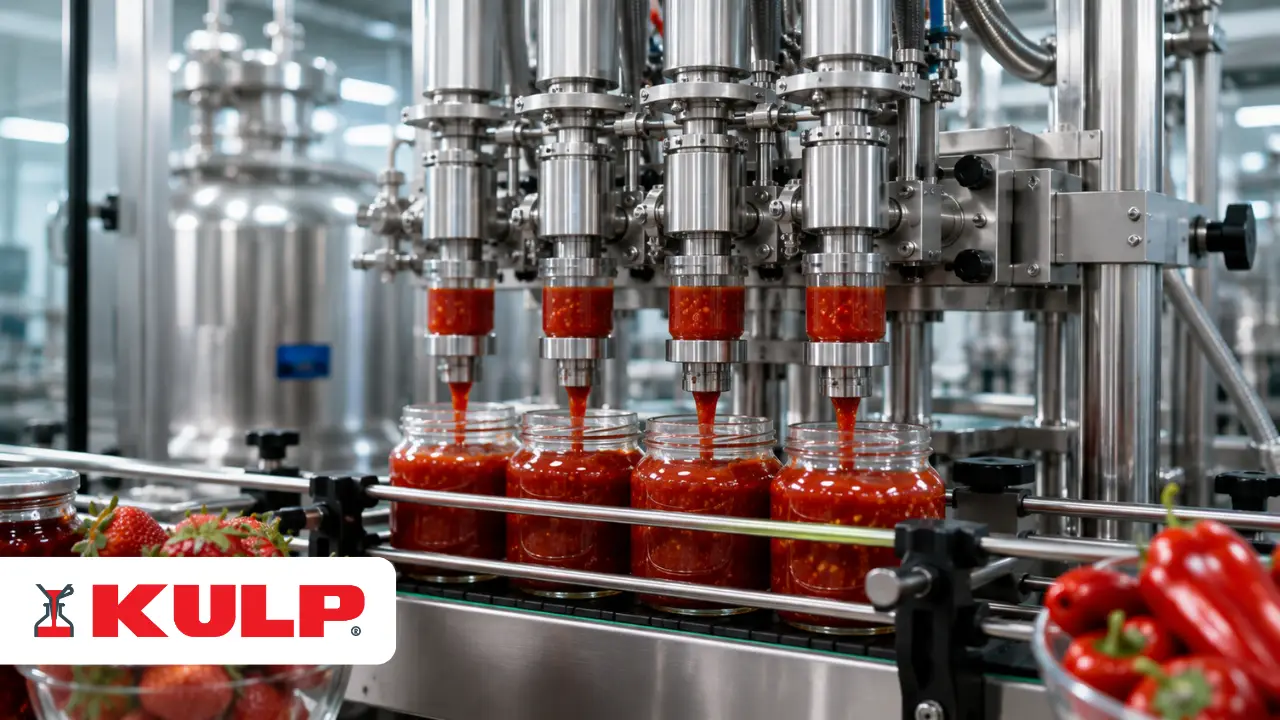
Some food products truly test a filling machine. They are not fluid like water, not completely homogeneous like cream, and not always consistent like smooth tomato paste. They may contain fruit pieces, pepper chunks, tomato fibers, spices, seeds, peels, vegetable pieces or larger particles.
For these products, standard filling logic is often not enough.
If you produce strawberry jam, sour cherry jam, orange peel marmalade, pepper tomato sauce, breakfast sauce, spicy paste, ajvar, salsa, chutney, roasted vegetable sauce, chunky pasta sauce or gourmet products with visible pieces, your filling machine directly affects your final product quality.
Because the real issue is not only filling a jar.
The real issue is this:
filling the product without crushing, breaking, separating or damaging the particles while maintaining accurate weight.
That requires proper machine engineering.
Why Is Chunky Product Filling Different from Standard Liquid Filling?
Standard liquid filling machines are usually designed for fluid or homogeneous products. Water, oil, vinegar, cologne and fruit juice can pass through narrower product lines because there are no particles that may get stuck, crushed or block the nozzle.
Chunky products are completely different.
The product does not simply “flow” or “fill.” It must be transferred together with its particles in a controlled way. These particles may be fruit pieces, vegetable chunks, spice mixtures or cooked product texture.
That is why the following questions are critical in chunky product filling:
- What is the base viscosity of the product?
- What is the size of the largest particle?
- Are the particles soft or firm?
- Will the product be filled hot?
- Is the packaging a glass jar, PET bottle, tin can or pouch?
- Do the particles settle at the bottom?
- Does the product foam, splash or stretch during filling?
- What is the target daily production capacity?
A machine purchased without answering these questions can create serious problems on the production floor. Chunky product filling is not only about motor power. It is about product path geometry, valve design, nozzle diameter and piston movement characteristics.
First Criterion: Particle Size and Product Path Width
The first technical point in chunky product filling is particle size. If the largest particle inside the product cannot pass easily through the narrowest point of the machine, two problems occur: blockage and crushing.
For example, a sauce containing small spice particles and a jam containing whole fruit pieces do not need the same machine design. Likewise, a finely chopped pepper breakfast sauce and a roasted vegetable ajvar with larger pieces require different product path structures.
The practical engineering rule is simple:
The largest particle in the product must pass comfortably through the narrowest point of the filling line.
Narrow valves, sharp turns, thin hoses, small nozzles or unnecessary restrictions can create problems in chunky product filling.
What Problems Does a Narrow Product Path Cause?
A narrow product path is one of the most common machine selection mistakes for particle-containing products. At first, the machine may seem to work. But as production continues, the problems begin.
A narrow product path may cause:
- Crushing of fruit or vegetable pieces
- Nozzle blockage
- Filling weight deviation
- Product splashing during filling
- Frequent operator intervention
- Increased product waste
- Uneven particle distribution between jars
- Longer cleaning time
Every stoppage in a production line is not only a time loss. It is also labor cost, product waste, energy loss and delivery risk.
Second Criterion: Why Does a Piston Filling System Stand Out?
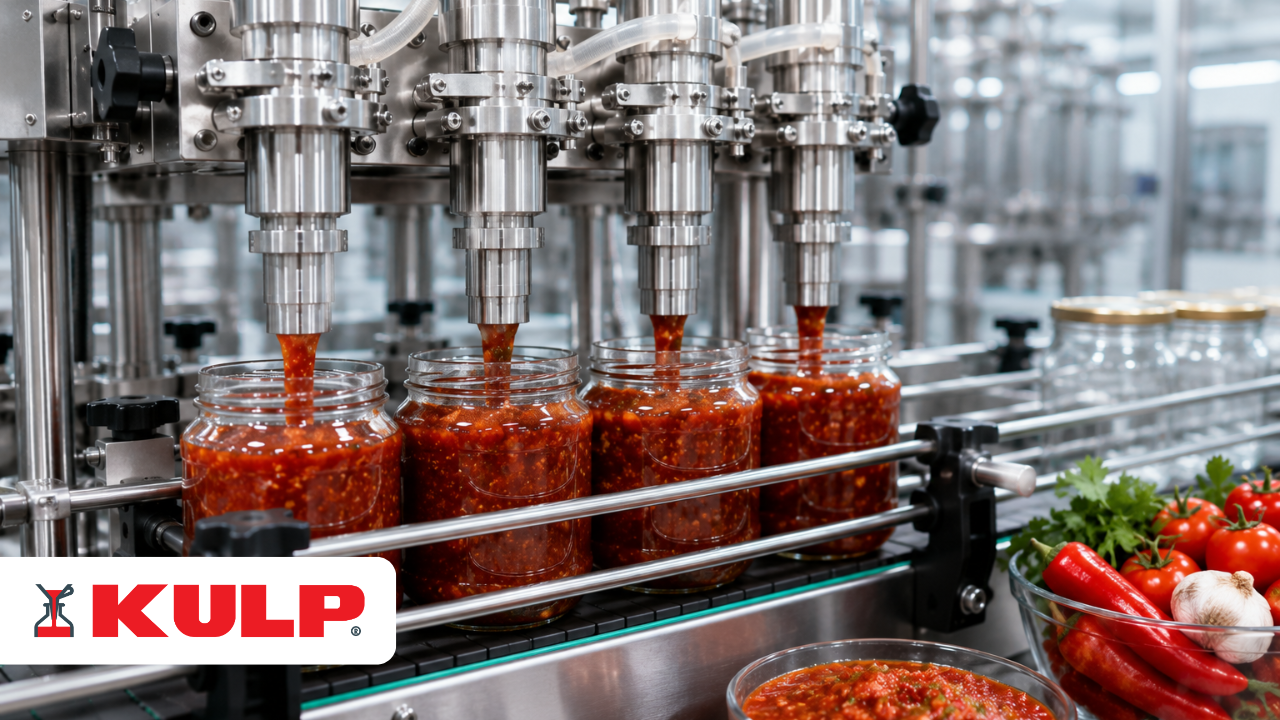
One of the most preferred systems for jam, sauce, paste and chunky products is the piston filling system. The reason is that piston systems can dose dense, semi-fluid and particle-containing products in a more controlled way.
In a piston filling system, the product is taken into a defined-volume chamber and transferred into the package with controlled movement. This offers an advantage for manufacturers that need volumetric accuracy.
However, there is an important detail:
Not every piston system is suitable for chunky products.
For particle-containing products, piston diameter, valve passage, product inlet-outlet path and nozzle diameter must be designed according to the product. A standard narrow-passage piston system can cause blockage and crushing in dense jams or sauces with larger particles.
What Should Be Checked in a Piston System for Chunky Products?
When choosing a piston filling system for chunky products, the following technical details must be evaluated carefully:
- Piston volume must match the filling weight
- Valve passages must be wide enough
- Product path should avoid sharp turns
- Nozzle diameter must match particle size
- Piston movement should not compress the product harshly
- Particles must remain homogeneous in the hopper
- Product contact surfaces must be easy to access for cleaning
At Kulp Makine, it is not enough to simply say “this is sauce” or “this is jam.” The product sample, particle structure, filling temperature, jar type and target capacity are evaluated together.
Because strawberry jam and orange peel marmalade do not behave the same. Pepper tomato sauce and spicy paste do not have the same flow characteristics either.
Third Criterion: Low-Shear Filling to Protect Particles
One of the most important engineering concepts in chunky product filling is low shear force.
Shear force refers to the mechanical stress that may break, crush or damage particles while the product moves inside the machine. If the product is forced through a narrow point with high pressure, pushed through sharp turns or passed through an unsuitable fast-running pump, the particles may be damaged.
For example, in whole-fruit jam, the fruit form should be preserved. In breakfast sauces, pepper and tomato pieces should maintain their natural texture. In ajvar or roasted vegetable sauces, the “homemade” texture often comes from the visible particle structure.
If the machine damages that texture, the product may still be filled into the jar, but its shelf quality decreases.
How Is Low-Shear Filling Achieved?
Low-shear filling depends on the following design details:
- Wide product passages
- Smooth and controlled piston movement
- Product path without unnecessary narrowing
- Suitable valve system
- Nozzle selected according to particle size
- Mixer design that does not damage the product
- Filling behavior that avoids unnecessary pressure increase
In chunky product filling, “stronger” does not always mean better. What matters is not brute force, but controlled force. Pushing the product into the jar is easy. The difficult part is filling it without damaging its structure.
Fourth Criterion: How Is Homogeneous Particle Distribution Achieved?
Another critical point in chunky product filling is homogeneous distribution. In other words, each jar should contain a similar ratio of sauce and particles.
In some products, particles may settle at the bottom. In others, lighter particles may rise to the surface. In certain jams, fruit pieces may gather in specific areas of the hopper. If the hopper and mixing system are not designed correctly, there may be serious differences between the first and last jars.
One jar may contain too many fruit pieces, while another may contain mostly syrup. That is a quality problem for the manufacturer.
Why Is Mixer Design Important?
Mixer design must be handled carefully in chunky products. The goal is not to break the product, but to keep particles evenly distributed.
An overly aggressive mixer may crush fruit and vegetable pieces. An insufficient mixer may allow particles to settle or cause the product to lose homogeneity.
For chunky products, the mixer should:
- Operate at low speed
- Move the product without breaking it
- Avoid dead zones inside the hopper
- Be suitable for product temperature and viscosity
- Be easily controlled by the operator
Kulp Makine evaluates hopper and mixer design according to the product. Because every manufacturer’s recipe is different. One producer may have a fluid sauce with small particles, while another may have a dense product with larger pieces.
Technical Details to Consider in Jam Filling
Jam filling is one of the most sensitive examples of chunky product filling. A jam contains both a dense syrup phase and fruit pieces. Also, many jams are filled hot.
Strawberry, sour cherry, fig, apricot, orange peel, blackberry or mixed fruit jams all have different particle structures. Some fruits are more easily crushed during filling, while others are more resistant.
Common Problems in Jam Filling
Jam manufacturers often face the following issues:
- Fruit pieces being crushed
- Uneven particle distribution between jars
- Imbalance between syrup and fruit ratio
- Dripping at the nozzle tip
- Gasket problems in hot filling
- Product contamination around the jar mouth
- Additional cleaning before capping
- Filling weight deviation
These problems are directly related to machine design. Correct piston volume, wide-passage valve, proper nozzle and temperature-resistant sealing elements make a real difference in jam filling.
Gasket and Seal Selection in Hot Filling
Jam is usually filled at a certain temperature. Hot product puts stress on gaskets, seals and other sealing components used inside the machine.
Incorrect gasket selection may cause leakage, deformation, particle contamination or loss of filling accuracy.
That is why sealing elements in hot jam filling must be selected according to product temperature and the sugary or acidic structure of the product. Materials such as Viton or Teflon may be evaluated for these applications from an engineering perspective.
Balance of Particles, Fibers and Spices in Sauce Filling
Sauce filling is a broad field in terms of product variety. Tomato sauce, pepper sauce, hot sauce, breakfast sauce, pasta sauce, pizza sauce, barbecue sauce, salsa, ajvar, chutney and regional sauces all have different flow characteristics.
Some sauces are completely smooth. Some are fibrous. Some contain pepper, tomato, onion, garlic, spice or vegetable particles.
In chunky sauces, the main goal is to fill the product while preserving its natural texture.
Factors Affecting Sauce Filling Machine Selection
The following technical criteria are important in sauce filling:
- Product viscosity
- Particle size
- Fibrous structure
- Hot or cold filling requirement
- Oil content
- Acidic structure
- Packaging mouth diameter
- Daily production capacity
- Whether different sauces will run on the same line
For example, pepper and tomato skins may accumulate in the nozzle in pepper tomato sauce. Ajvar and roasted vegetable sauces may be dense and fibrous. In salsa-style chunky sauces, preserving particle form is important.
For these products, narrow-passage standard liquid filling machines quickly become a burden for the operator.
Why Is Nozzle Design Critical in Chunky Products?
The filling nozzle is the final point where the product enters the package. In chunky products, if the nozzle is selected incorrectly, filling quality may suffer even if the rest of the machine is well designed.
If the nozzle diameter is too small for the particle size, the product may block or the particles may be crushed. If the nozzle is too wide, the product may flow uncontrollably, splash or contaminate the jar mouth.
Advantages of Proper Nozzle Design
A nozzle designed for chunky products provides the following advantages:
- Reduces blockage risk
- Helps particles pass without being crushed
- Supports weight consistency
- Reduces contamination around the jar mouth
- Decreases post-filling cleaning need
- Reduces operator intervention
- Makes production speed more sustainable
Nozzle selection is not a simple catalog decision. Testing with the real product sample is the most accurate method.
Packaging Type: Jar, Bottle, Tin and Doypack Differences
Packaging type directly affects machine selection in chunky product filling.
Glass jars are commonly used for chunky jam and sauces. Wide-mouth jars provide an advantage for products with larger pieces. However, keeping the jar mouth clean is important for capping quality.
PET bottles may have a narrower mouth. Therefore, particle size and nozzle diameter must be evaluated carefully.
Tin packaging may require larger filling volumes. For industrial use or Horeca channels, high-gram filling solutions may be needed.
In doypack packaging, controlled product entry through the pouch mouth and sealing quality after filling become important.
The Narrower the Package Mouth, the Higher the Risk
In chunky products, the narrower the package mouth, the more sensitive the filling process becomes. The nozzle diameter is limited by the package mouth. This can make particle passage more difficult.
That is why both the product sample and packaging sample must be evaluated when selecting a machine.
The correct approach is simple:
The product and the package must be considered together with the machine.
How Is Filling Accuracy Maintained in Chunky Products?
Filling accuracy is more difficult in chunky products compared to homogeneous liquids. This is because the liquid phase and particle phase move together in each filling cycle.
If one jar receives more particles and another receives more liquid, the weight values may vary. Product density may also change within the batch.
For accurate filling in chunky products:
- Homogeneity in the hopper must be preserved
- Piston volume must be adjusted correctly
- Product temperature must remain stable
- Filling speed must be optimized according to the product
- Nozzle blockages must be prevented
- Packaging tolerances must be considered
- Checkweighing systems may be used when necessary
The goal is not only to “fill the jar.” The goal is repeatable filling quality in every package.
Cleaning and Hygiene: Residue Risk Is Higher in Chunky Products
Chunky products can leave more residue inside the machine compared to homogeneous liquids. Fruit fibers, seeds, peels, spices and sugary structures can make cleaning more difficult.
Jam-like sugary products may leave sticky residue on surfaces. Sauces may leave oil, spice and fiber deposits inside the product path. If the machine is not easy to disassemble, cleaning time increases.
For hygiene in chunky product filling machines, the following features are important:
- Stainless product contact surfaces
- Easy-removable nozzle and valve structure
- Wide product passages
- Dead-zone-free design
- Cleaning points accessible to the operator
- Equipment resistant to hot water or suitable cleaning procedures
- Gaskets and seals selected according to the product
Kulp Makine’s local manufacturing advantage comes into play here as well. Cleaning-friendly revisions, special connections or product path arrangements can be planned faster according to the manufacturer’s product.
Semi-Automatic or Fully Automatic Line?
In chunky product filling, the automation level should be selected according to production capacity. Not every manufacturer needs a fully automatic line. For some SMEs, a semi-automatic filling machine is the right starting point. For others, automatic filling, capping, labeling and packaging should be considered as a complete line.
Semi-Automatic Solutions
Semi-automatic machines are suitable for low and medium-capacity manufacturers. They provide flexibility for businesses with high product variety, batch production and frequent recipe changes.
Advantages include:
- Lower initial investment cost
- Operator-controlled operation
- Easier adaptation to different packages
- Suitability for small and medium-scale production
- Flexibility for product testing
Fully Automatic Lines
Fully automatic lines are suitable for high-volume production facilities. Jar feeding, filling, capping, labeling and collection systems can be planned together.
Advantages include:
- Higher production capacity
- More standardized production flow
- Reduced labor requirement
- Repeatability in mass production
- More controlled line management
However, automation decisions should not be based only on today’s capacity. Growth targets for the next 2–3 years should also be considered. A manufacturer starting with a semi-automatic machine today may want to move to an automatic line tomorrow.
Kulp Makine considers the manufacturer’s growth plan with scalable solutions.
Typical Problems with Far East-Origin Machines
When choosing a machine for chunky product filling, looking only at the price tag is risky for manufacturers. Some machines that look affordable at first may create high costs on the production floor.
Especially in certain imported standard-design machines, the following problems may occur:
- Narrow valve passages unsuitable for the product
- Frequent blockage in chunky products
- Long spare part waiting times
- Electronic board and software support issues
- Gasket and nozzle incompatibility
- No possibility of product-specific revision
- Long service waiting times
- Insufficient operator training
Chunky product filling is a sensitive process. The machine must be shaped according to your product. Seeing “sauce filling machine” in a catalog does not mean that the machine will successfully fill your pepper sauce or large-fruit jam.
Local manufacturing provides a strong advantage here. You speak the same technical language with the machine manufacturer, you can reach the engineering team, you can test your product, and revisions can be made on the nozzle, piston, valve or product path when needed.
How Does Kulp Makine Provide Solutions for Chunky Product Filling?
Kulp Makine does not approach chunky product filling with a standard machine mindset. Instead, it offers product-focused engineering.
First, the product is evaluated:
- Is it jam, sauce or paste?
- Will the product be filled hot?
- What is the particle size?
- Are the particles soft or firm?
- What is the product viscosity?
- Is the package a glass jar, bottle or tin?
- What is the daily production target?
- Will the line be automated in the future?
Based on this information, the correct machine system is selected.
Kulp Makine’s key advantages in chunky product filling include:
- Product-specific machine design
- Wide product passages
- Piston solutions suitable for filling without crushing particles
- Gasket and seal options suitable for hot filling
- Stainless product contact surfaces
- Easy-clean design
- Semi-automatic and fully automatic line options
- Integration with capping and labeling systems
- Local service and spare part support in Türkiye
- Testing with real product samples
For Kulp Makine, the right machine is not only a machine that runs. The right machine protects the product, avoids unnecessary stoppages, supports the operator and grows with the manufacturer.
Frequently Asked Questions
Which machine should be preferred for chunky jam filling?
For chunky jam filling, wide-passage piston or volumetric filling systems are generally preferred. To avoid crushing fruit pieces, product path, valve structure and nozzle diameter should be selected according to the particle size of the jam.
Are pepper and tomato pieces crushed during sauce filling?
They may be crushed if the wrong machine is selected. Narrow product passages, high pressure and unsuitable nozzle design can damage particle form. Wide-passage systems working with low shear force reduce this risk.
Can chunky products be filled accurately by weight?
Yes. Accurate filling is possible with the right machine and proper product feeding system. However, in chunky products, homogeneity, product temperature, particle distribution and piston adjustment are important for weight consistency.
Can jam and sauce be filled on the same machine?
In some cases, the same machine can be adapted for different products. However, if jam and sauce have different viscosity, particle size, filling temperature and packaging structure, nozzle, gasket, piston setting or product path revisions may be required.
Is a chunky product filling machine easy to clean?
It depends on the machine design. Easy-removable nozzles, wide-passage valves, stainless product contact surfaces and dead-zone-free design shorten cleaning time. Cleaning ease must be evaluated carefully before purchasing a machine for chunky products.
Can a semi-automatic machine be converted into a fully automatic line later?
With proper planning, semi-automatic systems can be integrated into automatic lines in the future. That is why machine investment should consider both today’s capacity and future growth targets.
Does Kulp Makine test products with real samples?
Yes. In chunky products, the most accurate decision is made by testing the real product sample. Kulp Makine evaluates product viscosity, particle structure, packaging and target capacity to determine the most suitable filling solution.
Conclusion: The Right Machine for Chunky Products Protects Product Texture
Chunky product filling is not a simple filling process. The fruit pieces in jam, pepper particles in sauce, natural texture of paste and final shelf quality of the product must be protected.
That is why choosing a machine based only on capacity is not enough. Particle size, product viscosity, hot filling requirement, package mouth diameter, nozzle size, piston system, cleaning ease and service support must be evaluated together.
The industrial rule is clear:
A machine that does not understand your product can leave your production halfway.
Kulp Makine offers product-specific, locally manufactured, service-supported and field-ready engineering solutions for chunky jam, sauce, paste and particle-containing food products.
Bring your product and visit our factory in Türkiye. Let’s test your jam, sauce or chunky product with your own packaging in our demo center. See whether the particles are crushed, whether the weight is accurate and whether the filling is clean. Make your decision by seeing the real production result with your own eyes.